Early Life, Roots, and the Shape of a Famous Family
I see Mortimer W. Hall as a man born into a bright, complicated family tree, one that cast a long shadow and opened many doors. Born on July 21, 1924, in New York City, he entered the world as Mortimer Wadhams Hall, a name that carried old-money weight and social gravity. His mother was Dorothy Schiff, a powerful newspaper publisher whose influence reached deep into the city’s public life. His father was Richard Hall, also identified in family history as Richard B. W. Hall, a man with a quieter profile but an important place in the family story.
Mortimer grew up where ambition was almost atmospheric. Wealth, publishing, politics, and social status were part of the air he breathed. He attended St. Bernard’s School, then The Oxford Academy, and later Carnegie Tech. That educational path gave him a broad base, but it also hints at a life moving between privilege and self-definition. He was not simply a name in a family ledger. He became a broadcaster, an executive, an investor, and a man who made choices that shaped both business and home life.
World War II interrupted the arc of his youth. He served in the U.S. Army, an experience that likely marked him in ways the polished surfaces of public life never fully revealed. After the war, he moved west and began building a career that would tie him to radio, property, media ownership, and the shifting world of American commerce.
The Hall and Schiff Family Web
Mortimer’s family was large, layered, and often intertwined with public life. I think of it like a house with many rooms, each one holding its own story, its own voice, and its own set of loyalties.
Here is the family map as it appears in the public record:
| Family Member | Relationship to Mortimer W. Hall | Notable Details |
|---|---|---|
| Dorothy Schiff | Mother | Publisher, major New York figure |
| Richard Hall, also Richard B. W. Hall | Father | Less public than Dorothy, but part of the core family line |
| Adele Hall Sweet | Sister | Named as a sibling in later family records |
| Sarah Ann Kramarsky | Half sister | Dorothy Schiff’s daughter from another relationship |
| Mary Ann Parker | Wife | One of Mortimer’s spouses |
| Ruth Roman | Wife | Actress, married in 1950 |
| Diana Lynn | Wife | Actress and pianist, married in 1956 |
| Penelope Coker Wilson | Wife | His final wife and widow |
| Richard Hall, also known in some records as Richard Roman Hall | Son | One of his children |
| Matthew Hall | Son | Child from his marriage to Diana Lynn |
| Dorothy Hall, also called Dolly Hall | Daughter | Became a producer |
| Mary Hall Howland | Daughter | Later married Abbett Post Howland |
| Margaret Hall | Daughter | Child from his marriage to Diana Lynn |
| Eliza Ingle | Stepdaughter | Named in family and obituary records |
| Amanda Howland | Granddaughter | Named in family records |
| Diana Howland | Granddaughter | Named in family records |
| Jake Kochman | Grandchild | Named in family records |
Mortimer was the son of Dorothy Schiff, which placed him within one of the most influential newspaper families in the United States. He was also the grandson of Mortimer L. Schiff and Adele G. Neustadt on his mother’s side. That pedigree mattered, but it did not fully define him. He moved through it like a man learning how to carry both inheritance and independence at the same time.
His sibling structure also tells a story. Adele Hall Sweet and Sarah Ann Kramarsky appear in the family record, and Sarah Ann stands out as a half sister. That detail matters because it shows the family was not a simple straight line. It was branched, revised, and shaped by the human realities of marriage, separation, and time.
Marriages, Partnerships, and a Life Shared in Public
Mortimer’s marriages brought him into diverse public and private worlds.
The record lists Mary Ann Parker as his first wife. Her limited details make her feel like a figure glimpsed through a doorway, there in the story but unlit.
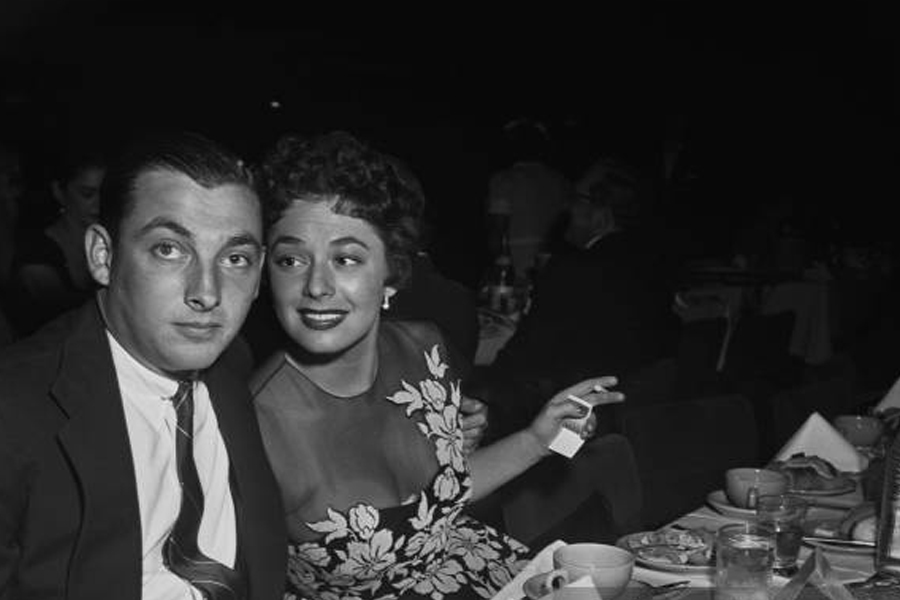
Marriage to Ruth Roman followed in 1950. Roman, an actress, married Mortimer into midcentury glamor. Studios, premieres, and society pages overlapped in their world. That union produced Richard Hall, sometimes spelled Richard Roman Hall. That naming itself feels like a bridge between public identity and private affection.
In 1956, Mortimer married Diana Lynn in Mexico. Lynn, an attractive musician and actress, was admired. Their marriage produced several children, and from the outside it seems to have formed one of the most visible family chapters in his life. Their kids were Matthew, Dorothy, Mary, and Margaret. Dorothy was known as Dolly, making the family portrait more personal.
His final wife was Penelope Coker Wilson (later Penelope Hall). His last years were spent with her, and the record implies a strong relationship. Life in Millbrook became more rural, with farming, fox hunting, sailing, animals, and communal bonds. That chapter is quieter and more grounded, like a symphony end turning to the earth.
Career, Money, and the Machinery of Media
Mortimer W. Hall built a career that combined ownership, management, and investment. After the war, he went to Los Angeles and became involved with KLAC, a radio station that he eventually bought. He became its chief executive officer and president, which tells me he was not content to remain in the background. He wanted the steering wheel.
In 1956, the station was assigned to his company, and the purchase price was reported at $850,000. That number gives a sense of scale. It was not a small local gamble. It was a significant move in the media business, one that placed him inside the machinery of broadcasting at a time when radio still had enormous influence.
His business interests did not stop there. He later became associated with Metro Communications and held major ownership stakes. He also took part in real estate activity through The Forward Hall Company, showing a range that extended beyond broadcasting into property and asset management. He was the kind of man who seemed to understand that influence often comes in layers, not just headlines.
In 1969, he returned to Manhattan and became treasurer of The New York Post. That position connected him directly back to the family enterprise shaped by his mother. It also completed a kind of circle. The boy from Dorothy Schiff’s world had moved through war, marriage, radio, land, and capital, and then returned to the newspaper universe that had helped define his name.
Financially, he was also tied to the Schiff trust structure, which shows that family wealth and legal stewardship were part of his adult life. He was not just an observer of inherited assets. He was part of their administration, and that role carries its own weight, its own pressure, and its own discipline.
Later Years, Home Life, and Legacy
In his final years, Mortimer lived in Millbrook, NY. His obituary depicts a life of bucolic pursuits and local involvement, which contrasts with his city origins and the high-gloss movies and media that shaped his marriages. That contrast is remarkable. Public flame to intimate ember feels like a bridge.
He died at 87 at home in Millbrook on March 2, 2012. He had witnessed nearly a century of American development, from publishing dynasties to broadcast consolidation, wartime service to postwar expansion, studio-era weddings to a family tree with grandchildren and beyond.
Extended Family Portrait
Mortimer’s family life was not a side note. It was central to his identity. Dorothy Schiff gave him a direct line into media power. Richard Hall gave him his paternal surname and another branch of ancestry. Adele Hall Sweet and Sarah Ann Kramarsky added sibling layers that show the family as living, shifting, and historically layered.
His marriages to Mary Ann Parker, Ruth Roman, Diana Lynn, and Penelope Coker Wilson map a life that crossed social circles and public eras. His children, Richard, Matthew, Dorothy, Mary, and Margaret, formed the next ring of continuity. Through them, the Hall name moved forward into another generation, and through his grandchildren, the family story kept unfolding in new hands.
FAQ
Who was Mortimer W. Hall?
Mortimer W. Hall was a New York born broadcaster, executive, investor, and member of the Schiff family. He is best remembered as the son of Dorothy Schiff, the owner and publisher connected to The New York Post.
Who were Mortimer W. Hall’s parents?
His mother was Dorothy Schiff. His father was Richard Hall, also identified in some family records as Richard B. W. Hall.
How many times was Mortimer W. Hall married?
He was married four times. His wives were Mary Ann Parker, Ruth Roman, Diana Lynn, and Penelope Coker Wilson.
Did Mortimer W. Hall have children?
Yes. The family record points to children named Richard, Matthew, Dorothy, Mary, and Margaret. Dorothy was also called Dolly.
What was Mortimer W. Hall’s main career?
He worked in broadcasting, most notably as owner and executive of KLAC in Los Angeles, and later served as treasurer of The New York Post.
What makes Mortimer W. Hall historically interesting?
He stood at the crossroads of media power, family wealth, and midcentury American celebrity. His life touched radio, newspapers, Hollywood, real estate, and the private architecture of a famous family.