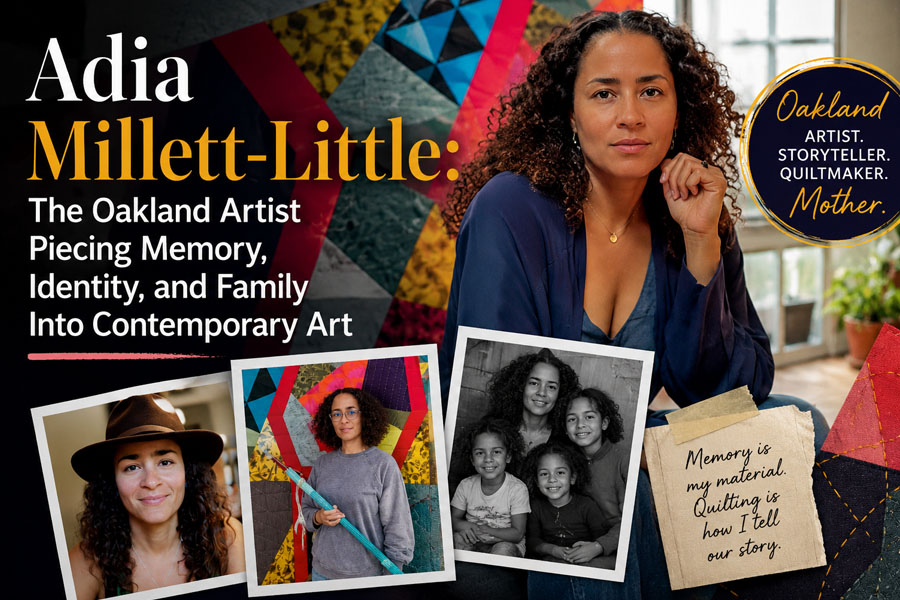
Basic Information
| Detail | Information |
|---|---|
| Full name | Adia Millett-Little |
| Birth year | 1975 |
| Birthplace | California, with accounts identifying Pasadena or Hollywood |
| Raised in | South Central Los Angeles |
| Current base | Oakland, California |
| Profession | Contemporary multimedia artist, educator |
| Education | BFA, University of California, Berkeley, 1997; MFA, California Institute of the Arts, 2000 |
| Artistic mediums | Sculpture, textiles, quilting, embroidery, painting, collage, drawing, installation, video, miniature dioramas |
| Major themes | Identity, memory, African American heritage, family, spirituality, nature, resilience, craft, architecture, Afrofuturism |
| Father | Cleavon Little |
| Mother | Diane Lewis |
| Stepfather | Architect, name not widely publicized |
| Notable recognition | Anonymous Was A Woman Award, 2021; 2026 SECA Art Award finalist |
| Based in | Oakland, California |
When I look at Adia Millett-Little’s career, I see an artist who treats memory almost like fabric. She cuts it, folds it, stitches it, separates it, and joins it again. The result is an expansive body of contemporary art that moves comfortably between quilting, sculpture, painting, installation, collage, embroidery, video, and miniature architectural scenes.
Born in 1975 in California, Millett-Little was primarily raised by her mother, Diane Lewis, in South Central Los Angeles. Her childhood was shaped by a family with strong creative and intellectual influences. Her biological father was actor Cleavon Little, while her mother had initially studied art before pursuing chemistry and eventually earning a doctorate in psychology. When Millett-Little was about seven years old, her mother married an architect who became a supportive presence in her upbringing and artistic development.
That mixture of art, architecture, science, psychology, performance, and personal history provides a fascinating backdrop to Millett-Little’s work.
Early Life and Family Background
Adia Millett-Little’s family story connects her to several different creative worlds.
Her father, Cleavon Jake Little, was born June 1, 1939, and became one of the most recognizable African American actors of his generation. His career included the Tony Award winning performance in Purlie and the unforgettable role of Sheriff Bart in Blazing Saddles. He also appeared in television productions, including Dear John, for which he received an Emmy Award.
Cleavon Little died on October 22, 1992, in Sherman Oaks, California, after battling colon cancer. Adia was his daughter and was among the surviving members of his immediate family.
Her mother, Diane Lewis, represents another important strand in Adia’s background. Lewis had an early interest in art but later pursued chemistry and psychology, ultimately earning a PhD in psychology. She primarily raised Adia and helped provide the foundation for a childhood in which intellectual curiosity and creativity could coexist.
Adia’s stepfather was an architect whose name has not been widely publicized. His profession is particularly interesting when viewed alongside Millett-Little’s later fascination with houses, structures, interiors, architecture, and miniature environments.
The paternal side of her family also includes several relatives connected to Cleavon Little.
| Family member | Relationship to Adia Millett-Little | Known for |
|---|---|---|
| Cleavon Little | Father | Actor, Tony and Emmy Award winner |
| Diane Lewis | Mother | Background in art, chemistry, and psychology |
| Unnamed architect | Stepfather | Supportive influence during Adia’s childhood |
| Malachi or Malchi Little | Paternal grandfather | Father of Cleavon Little |
| DeEtta Jones Little | Paternal grandmother | Mother of Cleavon Little |
| DeEtta Little West | Paternal aunt | Singer associated with “Gonna Fly Now” |
| Rosemarie Little Martin | Paternal aunt | Sister of Cleavon Little |
| Everett Little | Paternal uncle | Brother of Cleavon Little |
| Roy Little | Paternal uncle | Brother of Cleavon Little |
Public information about Millett-Little’s siblings, spouse, romantic relationships, or children is limited. She has generally maintained a private personal life, allowing her artwork rather than her domestic biography to occupy the center of public attention.
Education and Artistic Formation
Millett-Little earned her BFA from the University of California, Berkeley, in 1997. Three years later, in 2000, she completed an MFA at the California Institute of the Arts.
Her education was followed by opportunities that helped place her within a broader contemporary art conversation. In 2001, she participated in the Whitney Museum Independent Study Program. In 2002, she completed a residency at the Studio Museum in Harlem.
Teaching became another part of her professional identity. She has taught at institutions including Columbia College Chicago, the University of California, Santa Cruz, Cooper Union, and California College of the Arts.
I find that combination important because her practice has never been limited to one medium. She approaches art almost like an ecosystem. Painting can lead into textile work. Textile work can become sculpture. Sculpture can resemble architecture. Architecture can become a miniature stage for memory.
A Career Built From Many Materials
Millett-Little has worked for over 20 years. She created a visual vocabulary from different elements rather than a hallmark approach.
Inventing Truth, a 2001–2002 embroidery project, examined loss, memory, preconceptions, and identity. Important embroidery decision. Traditionally associated with domestic labor and feminine skill, it challenged conventional assumptions.
She created miniature dwellings and dioramas for her 2004–2010 Pre-Fabricated Innocence series. Tiny buildings became psychological settings. Constructions can raise problems about class, religion, innocence, voyeurism, and the narrative individuals project onto private areas.
Oakland, where Millett-Little opened her studio in 2010, became synonymous with her art and community activities.
Inspired by James Baldwin, her 2016 piece The Fire Next Time combined architecture, fragmentation, devastation, and transformation. Houses crumble, symbolizing instability and change.
Chosen Family examined quilting, cultural references, feathers, cloth, and relationships based on connection rather than biology in 2018.
Breaking Patterns Through Art
Many of Millett-Little’s artistic ideas revolve around “breaking patterns”.
Her procedure entails disassembling, cutting, removing, replacing, stitching, pasting, and rebuilding. Physical activities symbolize emotional and cultural experiences.
She highlighted these topics in her 2019 California African American Museum show Breaking Patterns. Broken architecture and abstract compositions showed that breaking something doesn’t entail destroying it. Sometimes fragmentation leads to a new shape.
Her work frequently investigates what occurs when familiar objects become unfamiliar.
Houses are no longer just houses. A quilt preserves memories. Cloth becomes history. Social expectations play out in a small setting. A discarded item tells another’s story.
Major Exhibitions and Recognition
Millett-Little has presented her work in solo and group exhibitions at significant art institutions.
Notable solo projects include:
| Year | Exhibition or project | Venue |
|---|---|---|
| 2019 | Breaking Patterns | California African American Museum |
| 2019 | Infinite Edges | Traywick Contemporary |
| 2021 | Force of Nature | di Rosa |
| 2023 | Wisdom Keepers | ICA San José |
| 2024 | Reflections on Black | Haines Gallery |
| 2025 | Warrior’s Portal | Chase Center |
Her work has also appeared in group exhibitions associated with institutions such as the New Museum, MoMA PS1, the Studio Museum in Harlem, the Oakland Museum, and the Barbican.
In 2021, she received the Anonymous Was A Woman Award, an important recognition for women artists whose work demonstrates sustained artistic achievement.
Her works have entered permanent collections, including the Crocker Art Museum. In 2026, she was named a finalist for the SECA Art Award at SFMOMA, further reflecting her position within the contemporary Bay Area art community.
Public Art and Community Connection
Millett-Little’s practice extends beyond gallery walls.
Her public projects demonstrate a strong interest in community, shared space, and collective identity. Taking Flight, a basketball court mural at Lowell Park in Oakland, connected contemporary art with an everyday neighborhood environment. The project also involved Zendaya.
Her Sunset/Sunrise project at UCSF expanded her work into another public setting, while Warrior’s Portal at Chase Center brought her visual language into a major sports and entertainment environment.
She has also participated in community-oriented projects such as the Little Free Antiracist Library. These activities reveal an important side of her practice: art is not merely something to look at. It can become a meeting place.
Identity, Memory, and African American Heritage
Identity is one of the deepest currents running through Millett-Little’s work.
Her art considers African American experiences without reducing them to a single narrative. Personal memory, family history, cultural inheritance, gender expectations, spirituality, and social structures overlap.
This is particularly evident in her use of textiles. Quilting can suggest ancestry because individual pieces retain their own visual identity while becoming part of a larger composition. The metaphor is powerful: a person can carry fragments of many histories and still form a coherent whole.
Her connection to Cleavon Little also places her within a notable African American entertainment legacy, although her own career has developed firmly within contemporary visual art rather than acting.
Craft, Domesticity, and the Everyday
Millett-Little gives extraordinary attention to ordinary materials.
Quilting and embroidery have historically been associated with domestic labor, family, patience, and women’s work. By bringing these traditions into contemporary fine art, she challenges assumptions about what materials are considered sophisticated or important.
Her miniature houses similarly transform familiar domestic architecture into something mysterious.
The ordinary becomes uncanny.
A tiny room can feel intimate and distant at the same time. A piece of fabric can look beautiful while carrying the weight of memory. A broken structure can suggest loss while simultaneously pointing toward renewal.
Afrofuturism, Nature, and Spirituality
Afrofuturism, nature, spirituality, and emotional resilience are also important to Millett-Little.
Human-environment interactions are often her focus. Organic forms, feathers, leaves, geometric structures, and abstract compositions can suggest earthly and speculative experiences.
Wisdom Goalkeepers emphasizes ancestry and spirituality. Her work can resemble futuristic relics, objects that seem to have survived from another time but belong to a future future.
Her work is powerful because of this past-future link. History isn’t locked up. We constantly enter, rearrange, and reinterpret it.
Career and Financial Profile
There is no reliable publicly disclosed figure for Adia Millett-Little’s net worth.
Her professional income may come from several areas typical of an established contemporary artist, including artwork sales, gallery representation, commissions, exhibitions, teaching, residencies, and public art projects. Her institutional exhibitions and commissions demonstrate a substantial professional career, but private financial figures should not be presented as fact without direct disclosure.
Recent Professional Activity
During 2024 through 2026, Millett-Little remained active through exhibitions, public projects, group shows, and community-oriented artistic work.
Her Reflections on Black exhibition continued her exploration of Black identity, memory, abstraction, and material culture. Her public art commissions have also expanded the settings in which audiences encounter her work.
Her Instagram presence under the handle @adiamillett provides glimpses into exhibitions, studio activity, public projects, and community initiatives. Even there, the emphasis remains on the work rather than extensive disclosure of her private life.
Extended Timeline
| Year | Milestone |
|---|---|
| 1975 | Born in California |
| Around 1982 | Mother married an architect who became a supportive stepfather |
| 1997 | Earned BFA from UC Berkeley |
| 2000 | Earned MFA from CalArts |
| 2001 | Participated in Whitney Museum Independent Study Program |
| 2002 | Studio Museum in Harlem residency |
| 2003 | Visiting artist at Columbia College Chicago |
| 2004 to 2010 | Developed Pre-Fabricated Innocence |
| 2010 | Established Oakland studio |
| 2016 | Created The Fire Next Time |
| 2018 | Created Chosen Family |
| 2019 | Breaking Patterns and Infinite Edges |
| 2021 | Received Anonymous Was A Woman Award; Force of Nature |
| 2023 | Wisdom Keepers and Taking Flight |
| 2024 | Reflections on Black and additional exhibitions |
| 2025 | Warrior’s Portal at Chase Center |
| 2026 | SECA Art Award finalist |
FAQ
Who is Adia Millett-Little?
Adia Millett-Little is an American contemporary multimedia artist based in Oakland, California, whose work spans textiles, sculpture, painting, collage, drawing, installation, video, embroidery, and miniature dioramas.
When was Adia Millett-Little born?
She was born in 1975 in California. Some accounts give February 2 as her birth date, while descriptions of her birthplace vary between Pasadena and Hollywood.
Who was Adia Millett-Little’s father?
Her father was actor Cleavon Little, best known for Blazing Saddles, Purlie, and Dear John. He died in 1992.
Who is Adia Millett-Little’s mother?
Her mother is Diane Lewis, who had an early background in art before studying chemistry and psychology and earning a doctoral degree in psychology.
Where did Adia Millett-Little study?
She earned a BFA from UC Berkeley in 1997 and an MFA from CalArts in 2000. She later participated in the Whitney Museum Independent Study Program and a Studio Museum in Harlem residency.
What themes appear in Adia Millett-Little’s art?
Her work explores identity, memory, African American heritage, family, spirituality, nature, emotional resilience, domestic craft, architecture, Afrofuturism, class, and the interconnectedness of living things.
Is Adia Millett-Little married?
Her marital or romantic status has not been extensively documented publicly, and she generally keeps her personal life private.
Does Adia Millett-Little have children?
There is no broadly confirmed public information identifying children.
What is Adia Millett-Little’s net worth?
No reliable public figure establishes her net worth. Her career includes artwork, exhibitions, teaching, commissions, and other professional activities, but specific earnings are not publicly disclosed.
What awards has Adia Millett-Little received?
Among her notable recognitions is the Anonymous Was A Woman Award in 2021. In 2026, she was also a finalist for the SECA Art Award.
Where does Adia Millett-Little live and work?
She is based in Oakland, California, where she maintains her artistic practice and participates in exhibitions and community projects.